By Dr. Vanessa Green | Vandor Consulting 7 June 2026
The evidence is finally catching up with the urgency. Here’s how to act on it.
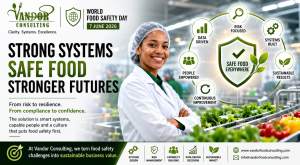
Every year on June 7, World Food Safety Day gives the global food industry a moment to stop, reflect, and recommit. This year, the theme is more urgent — and more actionable — than ever before:
“From Burden to Solutions – Safe Food Everywhere.”

Led by the World Health Organization (WHO) and the Food and Agriculture Organization (FAO), the 2026 campaign is doing something no previous edition has done: tying the call to action directly to a landmark data release. In June 2026, WHO is publishing updated global estimates of the foodborne disease burden — including, for the first time, national-level data on illness, death, and disability-adjusted life years (DALYs) caused by 31 foodborne hazards plus four heavy metals.
This is not background reading for South African food professionals. This is your operating context.
The burden is larger than most businesses acknowledge
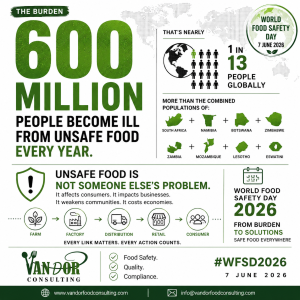
The numbers that have guided global food safety policy for a decade — 600 million foodborne illnesses and 420,000 deaths per year globally — were already alarming. The 2026 update will sharpen that picture considerably, providing the kind of granular, country-level data that allows regulators, businesses, and health authorities to move from broad concern to targeted intervention.
For South Africa, this matters enormously. Our food system carries specific structural vulnerabilities: the scale of informal food retail, cold chain infrastructure gaps outside major metros, water quality pressures in certain regions, and a regulatory compliance landscape that is still evolving. Against these realities, the global averages have always felt abstract. National data will change that.
The burden is not only a health burden. It is an economic one. Foodborne illness drives healthcare costs, workforce absenteeism, loss of consumer confidence, product recalls, and trade barriers. Every link in the food value chain that tolerates preventable risk is, in fact, a business making a costly strategic decision — whether it knows it or not.
The theme is a call for leadership, not just compliance
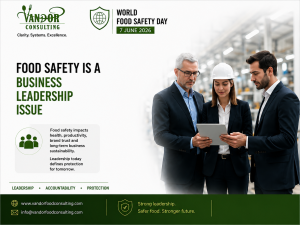
What makes the 2026 theme particularly compelling is its refusal to stop at awareness. “From Burden to Solutions” is an active instruction.
It asks food businesses not just to know that unsafe food is a problem — but to use the available evidence to identify where their specific risks are highest, and to act on that with precision and commitment.
This is the difference between a food safety management system that lives in a filing cabinet and one that drives operational decision-making every day. It is the difference between responding to a recall and preventing one. Between meeting minimum regulatory requirements and building a brand that consumers and retailers genuinely trust.
WHO’s three key messages for 2026 put it clearly: unsafe food makes people sick, harms livelihoods, and weakens economies. No one should get sick from food — it is preventable today and always. And science drives bold decisions and builds unshakeable public trust.
That third message deserves particular attention for business leaders: science builds trust. In an era of heightened consumer scrutiny and tightening market access requirements, the food businesses that invest in rigorous, evidence-based safety systems are building a durable competitive advantage.

What this means for your business in 2026
The release of WHO’s national foodborne disease estimates will create new pressure points — and new opportunities — for South African food businesses. Here is how we at Vandor Consulting recommend approaching this moment:
1. Audit your current risk landscape with fresh eyes. The new WHO data will identify which hazards are driving the greatest burden in our context. Use it to stress-test your existing Food Safety Management System. Are the hazards you’re controlling the ones that actually matter most in your category and region?
2. Reframe compliance as strategy. Regulatory compliance is a floor, not a ceiling. The businesses that will win in premium retail, export markets, and foodservice channels over the next five years are those that treat food safety as a strategic differentiator — not a cost to be minimised. Your HACCP plan, your cold chain protocols, your supplier audit programme: these are brand-building assets.
3. Invest in your people. The most sophisticated food safety system in the world is only as good as the people implementing it at 5am on a Tuesday. Consistent training, clear accountability, and a culture that empowers staff to raise safety concerns without fear are not soft benefits — they are operational necessities.
4. Connect food safety to your sustainability story. The global sustainability agenda and the food safety agenda are converging. Investors, retailers, and consumers increasingly expect food businesses to demonstrate how their operations protect both people and planet. Your food safety credentials are part of your ESG story.
5. Use the data now. WHO is releasing the 2026 foodborne disease burden report this month. Don’t let it sit in your inbox. Read it. Share it with your leadership team. Use it to make the case internally for the investment your food safety programme deserves.

Safe food everywhere — including here
South Africa has the expertise, the institutions, and the commitment to make “safe food everywhere” a reality, not just an aspiration. We have food safety professionals of real calibre. We have regulatory frameworks that are continuing to mature. We have food businesses that genuinely care about the people they serve.
What the 2026 theme asks of us — all of us — is to close the gap between knowing and doing.
At Vandor Consulting, we work with food businesses, producers, and organisations across South Africa to build the systems, strategies, and cultures that make safe food a daily operational reality. On World Food Safety Day and every other day of the year.
If your business is ready to move from burden to solutions — we would love to be part of that journey.
Contact Vandor Consulting
📩 info@vandorfoodconsulting.com 🌐 www.vandorfoodconsulting.com 📞 +27 71 227 7967
Services: Food Safety Audits · FSMS Design · Regulatory Compliance · Supply Chain Strategy · Sustainability Integration
Vandor Consulting (Pty) Ltd | Reg 2025/749113/07 | B-BBEE Level 1 Clarity. Systems. Excellence.
#WFSD2026 #WorldFoodSafetyDay #SafeFoodEverywhere #FoodSafetySA #VandorConsulting #FromBurdenToSolutions